

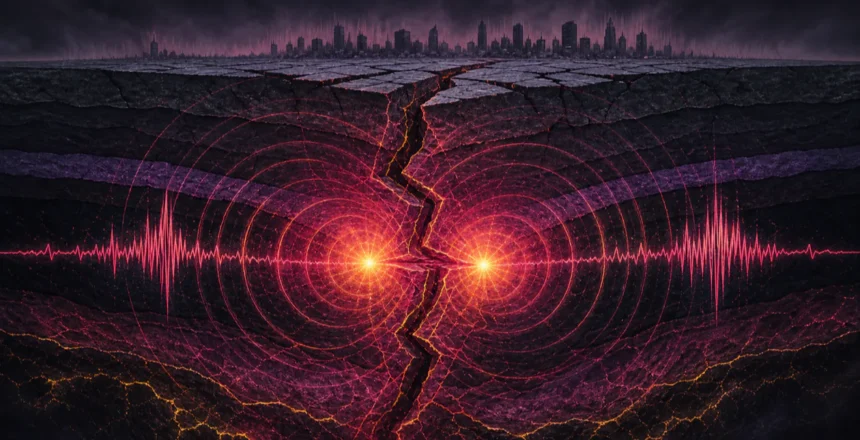
Two earthquakes, both above magnitude 7, struck northern Venezuela 39 seconds apart on 24 June 2026. Not a big quake and a smaller aftershock — two giants, back to back, in the same breath.
Seismologists have a name for this rare, unsettling event: a “doublet.” Here’s the science of why it happened, why the San Sebastián fault made Venezuela a sitting target — and the genuinely mind-bending question scientists are now arguing over: was it really two earthquakes, or one?
⚡ Quick Take
- What happened: A magnitude ~7.2 then ~7.5 quake hit northern Venezuela 39 seconds apart on 24 June 2026 (USGS) — a rare “doublet.”
- The science: Both ruptured the San Sebastián fault, where the Caribbean plate grinds past South America — much like the San Andreas.
- The twist: The USGS calls it two quakes; other agencies say it was one single, complex rupture.
What Actually Happened
At 18:04 local time on 24 June 2026, a powerful quake the US Geological Survey put at magnitude 7.2 struck near San Felipe in Yaracuy state, northern Venezuela. Thirty-nine seconds later, a second — magnitude 7.5 — hit almost the same spot (some agencies measured both even higher, around 7.6–7.8). Both were shallow, around 10–22 km deep, which is exactly the kind that does the most damage.
The human cost was severe. Authorities reported more than 1,400 people killed and over 3,000 injured, with many still missing as rescue teams reached collapsed areas — figures that were still being confirmed in the days after. The UN estimated billions of dollars in damage; coastal areas like La Guaira lost more than a thousand buildings, and Caracas’s main international airport was heavily damaged. It was, per reports, Venezuela’s strongest earthquake since 1900.
🔴 A note before the science: This was a real disaster with a heavy human toll. The explanation below is to help readers understand why it happened — not to treat a tragedy as a curiosity. Casualty figures are as reported by authorities and were still changing.
What Exactly Is a “Doublet” Earthquake?
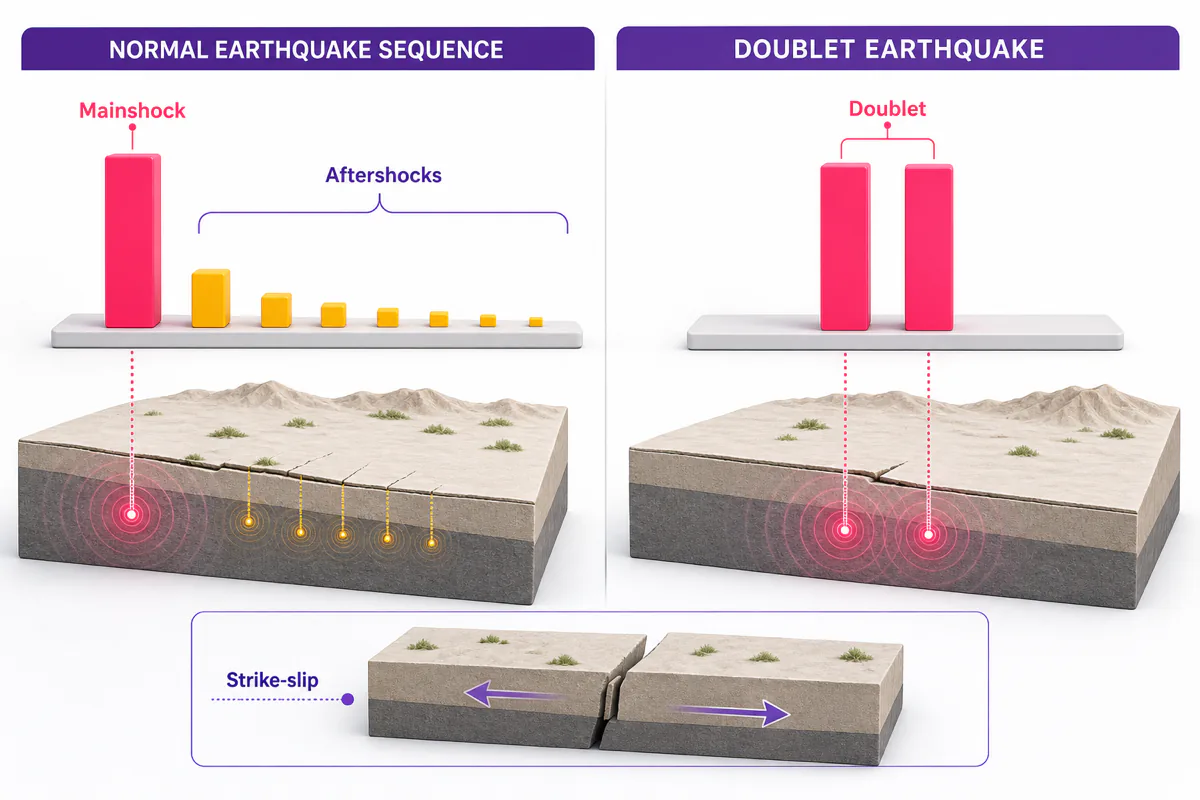
Here’s the part most people get wrong. In a normal earthquake sequence, you get one big mainshock followed by a string of much smaller aftershocks — the ground settling down, each jolt weaker than the last. That’s the pattern we’re used to.
A doublet breaks that rule. As the USGS defines it, it’s “a pair of similar-sized quakes” that hit close together in both location and time. The second one isn’t a baby aftershock — it’s a heavyweight, roughly as strong as the first. “A more typical pattern is a main shock followed by much smaller aftershocks,” explained Christine Goulet, director of the USGS earthquake science centre. A doublet is the rare exception, and that’s exactly why it’s so dangerous: it hits a region twice, hard, before anyone can even react.
And here’s the curiosity hook: doublets are rare, but they can happen almost anywhere, Goulet noted. Venezuela just drew the worst possible card.
Why Venezuela Sits on a Seismic Trigger
To understand the doublet, you have to understand the ground it happened on. Northern Venezuela sits on the boundary between two of Earth’s tectonic plates: the Caribbean plate and the South American plate. They aren’t crashing head-on — they’re sliding past each other sideways, with the Caribbean plate creeping eastward at roughly two centimetres a year.
That sideways grinding is called strike-slip faulting — “when two blocks of rock slide past one another horizontally,” as the USGS puts it. The fault that does it here is the San Sebastián fault, running east–west along Venezuela’s northern coast. If that setup sounds familiar, it should: Goulet compared the motion to California’s infamous San Andreas fault. Same type of boundary, same kind of locked-up, side-sliding stress — just under a different country.
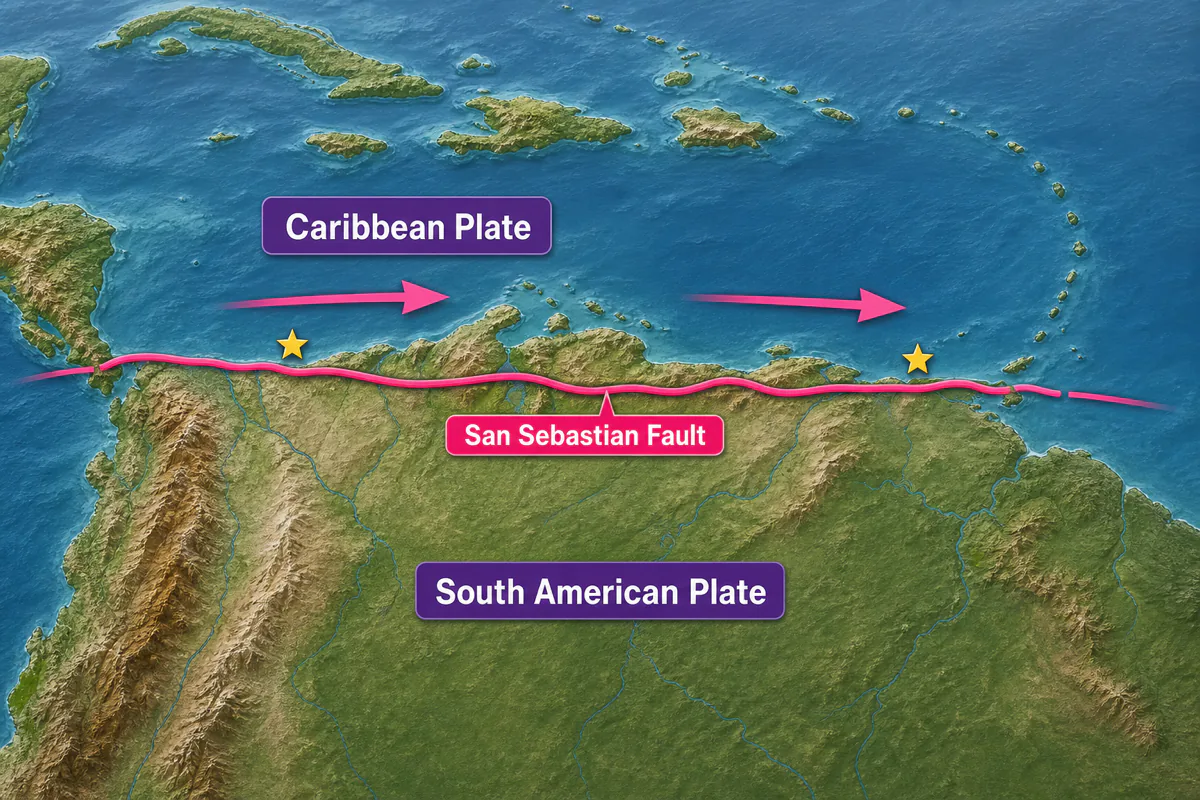
For years, stress had been quietly building along this fault as the plates tried to slide and the rock refused to budge. On 24 June, it let go — twice.
Why TWO Giant Quakes, 39 Seconds Apart?
So why didn’t the fault release all that energy in one go? The leading idea is stress transfer. When the first section of fault ruptures, it doesn’t just release energy — it dumps stress onto the neighbouring section, like shoving a loaded shelf next to another loaded shelf. If that next section was already near breaking point, the sudden extra push can tip it over the edge almost instantly. The result: a second major rupture, seconds after the first.
That’s the textbook explanation for a doublet — and it leads straight into the strangest part of this whole event.
🤯 The mind-bender: Was it even two earthquakes? The USGS officially logged the event as two separate quakes. But other major agencies — France’s GEOSCOPE and Italy’s INGV — argue it was actually one single, highly complex rupture that tore across the fault in one continuous motion. In other words, scientists can’t fully agree whether the planet shook once or twice. That debate is part of why this event is now being studied so closely.
Why Was It So Destructive?
Three things stacked up against northern Venezuela:
- It was shallow. At roughly 10 km deep, the energy had very little earth to travel through before hitting the surface — so the shaking arrived with brutal force.
- It hit twice. A doublet gives buildings no recovery time. Structures cracked by the first quake had 39 seconds before the second one finished the job.
- It struck a populated coast. The epicentre sat near densely built northern towns and not far from the Caracas region, where many older buildings weren’t designed for a one-two punch like this.
Goulet noted that damage also depends on factors like how the fault moved and how long the rupture was — but a shallow, double strike on a populated coastline is close to a worst-case combination.
Frequently Asked Questions
What is a doublet earthquake?
A doublet is a pair of similar-sized earthquakes that strike close together in both time and location, according to the USGS. Unlike a normal mainshock followed by much smaller aftershocks, the second quake in a doublet is roughly as powerful as the first — which makes doublets especially destructive.
Why did Venezuela get hit by two big earthquakes 39 seconds apart?
The leading explanation is stress transfer: when the first section of the San Sebastian fault ruptured, it dumped stress onto a neighbouring section that was already near breaking point, triggering a second major rupture almost immediately. The result was two magnitude-7-plus quakes in under a minute.
What is the San Sebastian fault?
It is a major strike-slip fault running east to west along northern Venezuela’s coast, marking the boundary where the Caribbean tectonic plate slides eastward past the South American plate. The USGS compared its motion to California’s San Andreas fault.
Was it really two earthquakes or one?
It depends who you ask. The USGS logged two separate earthquakes, while agencies such as France’s GEOSCOPE and Italy’s INGV characterised it as a single, highly complex rupture. Scientists are still studying the data, which is part of what makes this event scientifically important.
Can a doublet earthquake happen anywhere?
Doublets are rare compared with normal mainshock-aftershock sequences, but the USGS says they can happen almost anywhere there are active faults. Regions along major plate boundaries — like Venezuela’s northern coast or California — are the most exposed.
The Bottom Line
Venezuela’s “double disaster” wasn’t bad luck twice over — it was one fault system releasing decades of pent-up stress in a rare, vicious one-two punch that the science calls a doublet. The shallow depth, the strike-slip motion, and the second strike landing before anyone could react turned a powerful quake into a catastrophe.
And it leaves us with a humbling reminder: even now, the experts can’t fully agree whether the Earth shook once or twice that evening. That uncertainty is exactly why events like this matter — every doublet teaches seismologists a little more about the faults running quietly beneath millions of people, from Caracas to California.
Sources: Wikipedia: 2026 Venezuela earthquakes and the PBS NewsHour science explainer, citing the US Geological Survey and seismologist Christine Goulet. Magnitudes and casualty figures are as reported and were still being updated.